Menu

Show posts

This section allows you to view all posts made by this member. Note that you can only see posts made in areas you currently have access to.

Show posts Menu

Messages - Archangel

#256


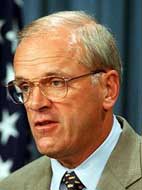
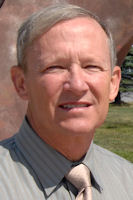
Jeff Ford. [Source: Thomas Doscher / US Air Force]
Personnel in NORAD's operations center in Cheyenne Mountain, Colorado, take part in a major Cold War-style training exercise called Vigilant Guardian, a war game in which the theoretical enemy is Russia. (9/11 Commission 3/1/2004 pdf file; Simpson 8/28/2011; Roeder 9/10/2011)

All of NORAD, including its subordinate units (see (6:30 a.m.) September 11, 2001), participates in the exercise. (Northeast Air Defense Sector 8/23/2001; Canadian Broadcasting Corporation 9/8/2011)

More than 50 people in the NORAD Battle Management Center in Cheyenne Mountain take part. (Tudor 3/2002; Doscher 9/8/2011)

Vigilant Guardian is an annual exercise and is scheduled to last two weeks. (Arkin 2005, pp. 545; Canadian Broadcasting Corporation 9/8/2011) It has been underway for several days. Those in the Cheyenne Mountain Operations Center (CMOC) have been participating in it "for at least three or four days," according to Lieutenant Colonel Steven Armstrong, NORAD's chief of plans and forces. (North American Aerospace Defense Command 9/9/2011)

Vigilant Guardian Is a 'Full-Blown Nuclear War' Exercise - Vigilant Guardian is a "transition to wartime operations command post exercise," according to an information page for its participants. (Northeast Air Defense Sector 8/23/2001)

The 1st Air Force's book about 9/11 will describe it as a "simulated air war." (Filson 2003, pp. 55) Lieutenant Colonel William Glover, the commander of NORAD's Air Warning Center, will later recall that it involves NORAD "simulating war.... You know, attacks coming from the outside, Soviet-style bombers coming in, cruise-missile attacks, that type of thing." (Canadian Broadcasting Corporation 9/8/2011)

Ken Merchant, NORAD's joint exercise design manager, will tell the 9/11 Commission that Vigilant Guardian is a "full-blown nuclear war" exercise, and includes bomber response and intercontinental ballistic missile response. (9/11 Commission 3/4/2004)
Russia Is Imagined Enemy - The theoretical enemy in the exercise is Russia. (Simpson 8/28/2011)

According to the 9/11 Commission Report, the exercise "postulated a bomber attack from the former Soviet Union." (9/11 Commission 7/24/2004, pp. 458) Merchant will explain that "NORAD must use Russia in its exercises at the strategic level since no other country poses a great enough threat to NORAD's capabilities and responsibilities." (9/11 Commission 3/4/2004)

Personnel Updated on Exercise during Shift Change - Armstrong will later recall that today starts off "like any other day. We came in thinking it would be a normal day... we did a standard shift changeover in the morning and we were getting right into where we were at in relation to the exercise." He will describe that in a shift change during the exercise, "We'd say, 'Okay, here's what happened during the night shift (or the day shift),' and we'd give each other an update, and then we'd start planning for whatever was on the agenda for that day." (North American Aerospace Defense Command 9/9/2011)

According to the Denver Post, after commencing his shift, Armstrong "mapped out strategy in a chess game of ever-escalating scenarios, from strained diplomacy to the outbreak of conventional warfare that headed inexorably toward nuclear conflict" with Russia. (Simpson 8/28/2011)

B-1 Bomber Scheduled to Fly out over Pacific Ocean - The "planned big event for the day" in the exercise is "supposed to be a B-1 bomber that was flying out of Fairchild Air Force Base [in Washington State] and going out over the Pacific," according to Jeff Ford, an Air Force lieutenant colonel who is working in the CMOC. Ford will add that there are "other things going on as part of the exercise, air exercise events, and then some scripted inputs that we were reacting to there in the Air Warning Center, whether it be unknown aircraft that we scramble aircraft for to intercept—or whatever." (Doscher 9/8/2011)

Exercise Posture Allegedly Helps Response to Attacks - Vigilant Guardian will reportedly end after 9:03 a.m., when the second plane hits the World Trade Center (see (Shortly After 9:03 a.m.) September 11, 2001), and the CMOC personnel participating in it will then become involved in responding to the real-world attacks. (Tudor 3/2002; Toronto Star 11/11/2008)

Glover will claim that the CMOC's response to the terrorist attacks benefits from the position the operations center is in for the exercise. He will say NORAD is "lucky" because "all the directorates such as operations, logistics, security, all those folks were up in the [Cheyenne] Mountain on an exercise posture." He will add that "these are the same folks that we would bring up in case of contingencies or in time of going to war. So, in reality, I had all the guys up into the NORAD Battle Management Center that I needed to conduct the exercise as well as the contingency operations that happened on 9/11." (Doscher 9/8/2011)

NORAD Monitoring Russian Exercise - NORAD was created in 1958, during the Cold War, to protect North American airspace against nuclear attacks from the Soviet Union. (Shenon 4/25/2004; Canadian Broadcasting Corporation 8/6/2004; Dick 11/2004)

According to the Toronto Star, "Whether it's a simulation or a real-world event, the role of the [CMOC] is to fuse every critical piece of information NORAD has into a concise and crystalline snapshot." (Simmie 12/9/2001)

As well as the Vigilant Guardian exercise, NORAD is currently in the middle of an operation called Northern Vigilance, with its fighter jets deployed to Alaska and Northern Canada to monitor an exercise being run by the Russian Air Force (see September 9, 2001). (North American Aerospace Defense Command 9/9/2001)

The battle staff members in Cheyenne Mountain are positioned to deal with both this operation and the exercise. (9/11 Commission 3/1/2004 pdf file)
#257


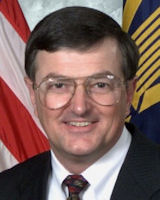
Thomas White. [Source: US Department of Defense]
Secretary of Defense Donald Rumsfeld hosts a breakfast meeting in his private dining room at the Pentagon. (Burns 9/12/2001; Rumsfeld 12/5/2001; 9/11 Commission 3/23/2004)

The meeting, which is attended by several members of Congress, is intended to discuss the Department of Defense's Quadrennial Defense Review. As well as the secretary of defense, others in attendance include Rumsfeld's senior military assistant, Navy Vice Admiral Edmund Giambastiani Jr.; Deputy Defense Secretary Paul Wolfowitz; Pete Geren, a special assistant to Rumsfeld; and Representatives John Mica (R-FL), Mark Steven Kirk (R-IL), Mac Thornberry (R-TX), Roger Wicker (R-MS), Robin Hayes (R-NC), Doug Bereuter (R-NE), John Hostettler (R-IN), Kay Granger (R-TX), John Shimkus (R-IL), Randy "Duke" Cunningham (R-CA), and Christopher Cox (R-CA). (Powell Moore 9/10/2001 pdf file; Mahlburg 9/14/2001; Powell Moore 9/19/2001 pdf file; Hasson 3/31/2003; Wolfowitz 5/9/2003; Rumsfeld 9/10/2004; Miles 9/8/2006)

Secretary of the Army Thomas White, who is at the meeting, appears to say it is also attended by numerous key military figures, later telling PBS: "Don Rumsfeld had a breakfast, and virtually every one of the senior officials of the Department of Defense—service chiefs, secretary, deputy, everybody, chairman of the Joint Chiefs of Staff. And as that breakfast was breaking up, the first plane had hit the World Trade tower." (White 10/26/2004; PBS 10/26/2004)

By "chairman of the Joint Chiefs of Staff," White presumably means Richard Myers, who is the acting chairman on this day, in place of Henry Shelton who is out of the country (see 7:15 a.m. September 11, 2001). (Garamone 9/8/2006)

During the course of the meeting Rumsfeld predicts that some kind of "shocking" world event will occur in the near future (see (Before 8:46 a.m.) September 11, 2001).

Most accounts suggest the meeting is adjourned soon after the time the first World Trade Center tower is hit, presumably around 8:50 a.m., though one report says it ends at about 9:00 a.m. Just prior to the meeting ending, Rumsfeld is handed a note informing him of the crash (see Shortly After 8:46 a.m. September 11, 2001). Giambastiani also sees this note. Whether the other people in attendance are notified of the crash at this time is unknown. (Rumsfeld 12/5/2001; Rumsfeld 8/12/2002; PBS 10/26/2004; Miles 9/8/2006)

White will later recall, "We all went on with the day's business," after leaving the meeting. White heads off to give a speech at the nearby Army Navy Country Club. (White 10/26/2004) Rumsfeld, Wolfowitz, and Giambastiani return to their offices. (Wolfowitz 5/9/2003; Miles 9/8/2006)

The members of Congress leave the building. (Rumsfeld 1/9/2002) If Myers is at the meeting, as White appears to say, he must head promptly to Capitol Hill, as he enters another meeting in the offices of Senator Max Cleland (D-GA) before the time when the second WTC tower is hit (see Shortly Before 9:00 a.m. September 11, 2001). (Armed Forces Radio And Television Service 10/17/2001; Rhem 10/23/2001)
#258
Many aircraft at Andrews Air Force Base, which is just a few miles outside Washington, DC, are taking part in training exercises. James Ampey, an FAA air traffic controller who is currently on duty in the control tower at the base, will later recall that there are "an unusually high number of aircraft taking off and landing at Andrews [this] morning, because previously scheduled military exercises are underway." (9/11 Commission 7/28/2003 pdf file)

It is unclear what specific exercises these aircraft are participating in, and the exact time period Ampey is referring to.

Militarized 747 Involved in 'Global Guardian' Exercise - According to journalist and author Dan Verton, around the time of the Pentagon attack, "civilian and military officials [are] boarding a militarized version of a Boeing 747, known as the E-4B National Airborne Operations Center (NAOC), at an airfield outside of the nation's capital. They are preparing to conduct a previously scheduled Defense Department exercise" (see (9:27 a.m.) September 11, 2001). (Verton 2003, pp. 143-144)

This airfield is Andrews Air Force Base and the exercise being referred to is the US Strategic Command's annual exercise, Global Guardian, for which three E-4Bs are launched (see 8:30 a.m. September 11, 2001 and Before 9:00 a.m. September 11, 2001). (Dejka 2/27/2002; Kieschnick 9/7/2012 pdf file)

Whether other aircraft that are taking off or landing at Andrews are participating in Global Guardian is unknown.

NORAD Exercise, 'Vigilant Guardian' - Another major exercise taking place this morning is called Vigilant Guardian. All of the North American Aerospace Defense Command (NORAD) is participating in it (see (6:30 a.m.) September 11, 2001). (Seely 1/25/2002; Scott 6/3/2002)

However, Andrews is not one of NORAD's seven "alert" sites around the US. (McKenna 12/1999) And the 113th Wing of the District of Columbia Air National Guard, which is based at Andrews, is not part of the NORAD air defense force. (Scott 9/9/2002; Filson 2003, pp. 76)

Furthermore, members of the 113th Wing have just returned from a major training exercise in Nevada (see Late August-September 8, 2001), and so, with only a few pilots and planes available, today is a "light flying day" for their unit. (9/11 Commission 3/11/2004 pdf file)

Presumably the 113th Wing is therefore not currently participating in Vigilant Guardian or any other major exercises.

Numerous Units at Andrews - There are, however, many units at Andrews that may be participating in exercises. Among more than 60 separate organizations located at the base are units from the Army, Navy, Marine Corps, Air Force Reserve, and Air National Guard. (DC Military (.com) 6/2001; GlobalSecurity (.org) 1/21/2006)

These units include Marine Fighter Attack Squadron 321 (VMFA-321), which flies the F/A-18 Hornet fighter jet, and Naval Air Facility, Washington, DC, which has numerous aircraft available, including the F/A-18 Hornet. (DC Military (.com) 2/9/2001; DC Military (.com) 6/2001)
Andrews Units Respond to Attacks - DC Air National Guard fighters will later take off from Andrews to protect Washington in response to the morning's attacks (see (10:38 a.m.) September 11, 2001, 10:42 a.m. September 11, 2001, and 11:11 a.m. September 11, 2001). (Scott 9/9/2002)

And a member of VMFA-321 calls NORAD's Northeast Air Defense Sector (NEADS) at around 9:50 a.m. to offer his unit's assistance in response to the attacks (see (9:50 a.m.) September 11, 2001). (Spencer 2008, pp. 188)
#259
A helicopter and its crew that are always on standby for "contingency" missions in the Washington area are away from base early this morning conducting a traffic survey, but apparently return at some point before the Pentagon is hit. The crew belongs to the 12th Aviation Battalion. (Exempt 11/14/2001 pdf file; Exempt 11/14/2001 pdf file)

The 12th Aviation Battalion is stationed at Davison Army Airfield at Fort Belvoir, located 12 miles south of the Pentagon. It is the aviation support unit for the Military District of Washington, and operates UH-1 "Huey" and UH-60 Black Hawk helicopters. (Military District of Washington 8/2000)

According to a chief warrant officer with the unit, the 12th Aviation Battalion has "two crews that are always on standby for any kind of contingency mission." It is one of these crews that is "out flying around doing a traffic survey." (Exempt 11/14/2001 pdf file)

The exact time period during which the crew and their helicopter are away from base is unstated, but they apparently return to Davison Airfield before 9:37 a.m., when the Pentagon is hit (see Shortly Before 9:37 a.m. September 11, 2001). (Exempt 11/14/2001 pdf file)

They will be the first crew with the battalion to take off in support of the rescue operations at the Pentagon once the unit's aircraft are permitted to launch again following the attack. Others members of the 12th Aviation Battalion are also away from base this morning, for weapons training (see 8:46 a.m.-9:37 a.m. September 11, 2001). (Exempt 11/14/2001 pdf file)
#260


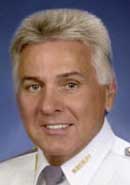
Charlie Wells. [Source: Publicity photo]
Having returned to the Colony Beach and Tennis Resort after his morning jog, President Bush meets for a brief chat in his penthouse suite with Manatee County Sheriff Charlie Wells, Sarasota County Sheriff Bill Balkwill, Sarasota Police Chief Gordon Jolly, and Manatee County Sheriff's Colonel Ken Pearson. Wells later recalls the president was "totally unsuspecting about what is to happen.... It looked like, to me, he's saying, 'Glad to see you, but I'm ready to get on to the school and meet the kids.'" The four law enforcement officials will later travel to the Sarasota school in the president's motorcade. (Sammon 2002, pp. 36; Bayles 9/10/2002)
#261
The daily threat briefing at NORAD's Northeast Air Defense Sector (NEADS) includes no indication of any increase in the terrorist threat level. Lieutenant Colonel Mark Stuart, an intelligence officer working in the NEADS battle cab, will tell the 9/11 Commission that for his threat briefing today, there is "'zero' intelligence available concerning any increase in the terrorist threat level." He will say that a briefing two days ago, on September 9, similarly "contained nothing on the terrorist threat." Stuart will say the last briefing at NEADS that mentioned the threat posed by Osama bin Laden was on July 14, "as part of the increased threat warning during summer 2001" (see July 14, 2001). (9/11 Commission 10/30/2003 pdf file; 9/11 Commission 1/20/2004)

NEADS, which is based in Rome, New York, will be responsible for coordinating the US military's response to the hijackings later this morning (see 8:45 a.m. September 11, 2001 and 9:24 a.m. September 11, 2001). (Bronner 8/1/2006; Shenon 2008, pp. 203)
#262


Brenton Greene. [Source: National Communications System]
CIA representatives give a briefing to a little-known government agency called the National Communications System (NCS) at a facility just outside Washington, DC, where they discuss the threat that international terrorists pose to the US's telecommunications infrastructure. The NCS is a relatively small agency that works to ensure the uninterrupted availability of critical communications networks during times of national crisis. It will play an important role in the response and recovery efforts following the terrorist attacks in New York and at the Pentagon, when damage to the World Trade Center area severely impairs the local telecommunications infrastructure. (Verton 2003, pp. 135-137; National Communications System 2004, pp. 56 pdf file)

Briefing Attended by Public and Private Sectors Representatives - The briefing is held at what journalist and author Dan Verton will call "a secure facility outside of Washington, DC." Presumably this is the NCS's National Coordinating Center in Arlington, Virginia. Attendees include Brenton Greene, the director of the NCS since April 2001, and representatives from seven other federal agencies and over 40 technology and communications companies that operate many of the US's most critical communications networks. The representatives from the private sector, according to Verton, are all "senior executives from their respective companies, and all had government security clearances that granted them access to the most sensitive intelligence data pertaining to threats to the infrastructures that formed not only the lifelines of their businesses but the lifelines of the nation as well."
CIA Outlines Threat to Telecommunications Infrastructure - Although Greene is a 25-year veteran of the Navy's submarine force and is "used to classified briefings and operating in the shadows," the current briefing, according to Verton, promises "to be different from any other he had taken part in." The CIA representatives begin it at 8:00 a.m. by outlining the growing international terrorist threat to the US telecommunications infrastructure. Terrorists Aware of Benefits of Targeting Telecommunications - Verton will describe that the briefing participants then agree that there is "a growing body of evidence relating to the increased sophistication in information warfare (IW) capabilities of foreign nations." Additionally, a cyber-attack against computer systems in the US "would likely involve a major disruption of key telecommunications infrastructures serving other sectors of the economy, including banking and finance, electric power, and air traffic control." Greene will later comment: "Everything runs on telecom. If it's a major cyber-event, it's going to have a physical tail. If it's a major physical event, it's going to have a cyber-tail." The CIA representatives say that some terrorist organizations are also becoming aware of the potential offered by targeting the telecommunications infrastructure.

Briefing Continues despite News of First Crash - Shortly after 8:46 a.m., when the first plane hits the WTC, Navy Captain J. Katharine Burton enters the briefing room and whispers to Greene the news of what has happened. With no further information available and no evidence that the crash was anything more than an accident, Greene calmly passes on the news to the other people in the room, and then orders the briefing to continue. The CIA representatives therefore go on until news arrives of the second plane hitting the WTC at 9:03 a.m., and televisions are turned on to CNN, which is showing live coverage from New York. Greene will later recall: "It was clear then that there was some threat. When the second plane hit, I said: 'I'm leaving. I need to go look at the implications of this.'" (Verton 2003, pp. 135-139, 141)

9/11 Attacks Are 'the Most Significant Challenge' to the NCS - The NCS will play a key role in the government's response to the 9/11 attacks, which result in severe damage and impairment to the telecommunications infrastructure serving the area around the WTC. (National Communications System 2004, pp. 56 pdf file) Greene will later recall that the destruction caused by the attacks becomes "the most significant challenge that the National Communications System had ever seen." (Verton 2003, pp. 151) The NCS's National Coordinating Center is activated, and supports response and recovery efforts (see (8:48 a.m.) September 11, 2001). After leaving the briefing, Greene will head to his "Continuity of Government" site, from where the status of the communications network is constantly monitored, and priorities and repairs are coordinated. (9/11 Commission 3/16/2004 pdf file)

#263
At Langley Air Force Base in Virginia, one of the pilots that will take off to defend Washington in response to the terrorist attacks (see (9:25 a.m.-9:30 a.m.) September 11, 2001) asks to be removed from "alert" status later this morning, so he and another pilot can participate in a training mission. (Sullivan 8/19/2002; Spencer 2008, pp. 116)

Being on "alert" means that a pilot's fighter jet is kept on the runway, armed, fueled up, and ready to take off within minutes if called upon. (Hebert 2/2002; Kelly 12/5/2003)

Pilot Requests 'Download' - The pilot, Major Dean Eckmann, calls NORAD's Northeast Air Defense Sector (NEADS) and requests that he be removed from alert status at 11:00 a.m. He wants to be able to join in with a scheduled training mission being conducted from Langley Air Force Base, along with another pilot from his unit, Captain Craig Borgstrom. (Borgstrom is not one of the unit's alert pilots, but will take off along with Eckmann in response to the terrorist attacks.)

According to author Lynn Spencer, such requests for removal from alert status—known as "download"—are customary, "since the detachment typically flies two training missions each week, and as long as the other NORAD alert sites on the East Coast—at Otis [Air National Guard Base] on Cape Cod and Homestead [Air Reserve Base] in Florida—are up on alert, the requests are generally approved." (Spencer 2008, pp. 116 and 141-144)

Alert Duty Usually Uneventful - The alert unit at Langley Air Force Base is in fact part of the North Dakota Air National Guard's 119th Fighter Wing, which has a small detachment at Langley, located away from the base's central facilities. The unit is housed in two cramped buildings, and has just four aircraft and 18 full-time members of staff. (Spencer 2008, pp. 114)

According to journalist and author Jere Longman, being on alert duty is usually fairly uneventful for the pilots involved: "Protecting American airspace from attack was not a demanding job before September 11.... A week at Langley was a time to relax, watch television, work out, spend time on the computer, catch up on business. Like firemen, the pilots sat and waited for something to happen. When it did, they were usually scrambled to escort Navy jets with transponder problems to their home bases. Or to find doctors lost over the ocean in their Beechcraft Bonanzas. Or, occasionally, to sniff out drug runners. It was a sleepy job. Dozing for dollars, they called it." (Longman 2002, pp. 64)
#264
Two passengers leave Flight 93 after hearing an announcement that there will be a five-minute delay in the plane pushing back from the gate. This is according to Terry Tyksinski, a longtime flight attendant with United Airlines, who says a customer service supervisor who witnessed the incident told her about it six months after 9/11. The two first-class passengers are reportedly of dark complexion, "kind of black, not black." According to Tyksinski, the supervisor notes their names and is subsequently twice interviewed by the FBI. (Longman 2002, pp. xiii-xiv)

No other accounts, including the 9/11 Commission Report, mention this incident. (9/11 Commission 7/24/2004) And while Flight 93 is delayed on the ground until 8:42 a.m., reports state that it pushes back from the gate just one minute later than its scheduled departure, rather than there being a five-minute delay as Tyksinski suggests. (Johnson 11/23/2001; Pauley 9/11/2006)

There will only be 37 passengers on Flight 93, including the four hijackers. This is 20 percent of the plane's passenger capacity of 182 and, according to the 9/11 Commission, "is considerably below the 52 percent average load factor for Flight 93 for Tuesdays in the three-month period prior to September 11." (9/11 Commission 8/26/2004, pp. 36)
#265


A map of the paths all hijacked planes and relevant fighters take on the
morning of 9/11. Source: Yvonne Vermillion/ MagicGraphix.com
American Airlines Flight 11, a Boeing 767 with 92 people aboard. Flight 11 takes off from Boston's Logan International Airport en route to Los Angeles, 14 minutes after its scheduled 7:45 departure time.

Sources:

Washington Post 9/12/2001
CNN 9/17/2001
Lichtblau 9/20/2001
Ellison 10/17/2001
ABC News 7/18/2002
Associated Press 8/21/2002
Adcock 9/10/2002
9/11 Commission 6/17/2004

#266
Hijackers Mohamed Atta and Abdulaziz Alomari board Flight 11. Atta's bags are not loaded onto the plane in time and will later be found by investigators. Investigators will discover airline uniforms in one of the bags. (Cullen and Ranalli 9/18/2001)

It will not be explained why Atta would have obtained these uniforms only to put them in his checked-in baggage, where he would be unable to access them.
#267
Hijacker Mohamed Atta on Flight 11 calls hijacker Marwan Alshehhi in Flight 175 as both planes sit on the runway. They presumably confirm the plot is on. (Time 8/4/2002)
#268
American Airlines Flight 11 pushes back from the gate at Boston's Logan Airport. (9/11 Commission 7/24/2004, pp. 2)

There are discrepancies over which gate it leaves from. Most early reports state that it pushes out from Gate 26 in Terminal B of the airport. (Howe and Brelis 9/12/2001; Lawrence, Warmbir, and Sweeney 9/13/2001; Alderson et al. 9/16/2001; Maraniss 9/16/2001; Bernstein 2002, pp. 179; Der Spiegel 2002, pp. 36)

However, one unnamed Logan Airport employee will say it leaves from Gate 32, also in Terminal B. (Kurkjian and Lewis 9/11/2001) The transcript of radio communications with the flight confirms it left from Gate 32, and the 9/11 Commission also later states this. (New York Times 10/16/2001; 9/11 Commission 7/24/2004, pp. 451)

The reason for the discrepancy in these reports is unclear. Flight 11, a Boeing 767 with a capacity of 158 passengers, is about half full on this day, with 81 passengers on board (including the five hijackers), along with the two pilots and nine flight attendants. (9/11 Commission 8/26/2004, pp. 6)

It will take off at 7:59 (see (7:59 a.m.) September 11, 2001). (9/11 Commission 7/24/2004, pp. 4)
#269
An unnamed gate agent at Logan Airport in Boston calls Donald Bennett, the crew chief for Flight 11, and asks him if the two suitcases of a passenger who has just boarded the plane have arrived from US Airways. Bennett replies that the suitcases, which belong to lead 9/11 hijacker Mohamed Atta, have arrived, but Flight 11's baggage compartment has already been locked for departure, so they will not be loaded. Atta flew from Portland to Boston on a Colgan Air flight operated for US Airways (see (6:00 a.m.) September 11, 2001).

American Airlines baggage expediter Philip Depasquale will later claim that bags from US Airways are always late, and so this problem is a common occurrence. The luggage is turned over to Depasquale to have it sent to Los Angeles on another flight. According to Salvatore Misuraca, a ramp service manager for American Airlines at Logan Airport, gate agents do not usually call about a bag unless the passenger that owns it has specifically asked about it, to ensure that their bags have been put on their flight. Atta's luggage will remain at Logan Airport and be found after the attacks, revealing important clues (see September 11-13, 2001). (Federal Bureau of Investigation 9/11/2001; Federal Bureau of Investigation 9/17/2001; 9/11 Commission 2/10/2004)
#270


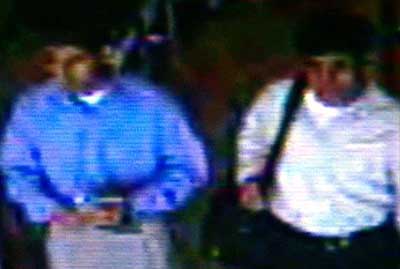
Hijacker brothers Salem (white shirt) and Nawaf Alhazmi
(dark shirt) pass through security in Dulles Airport in
Washington. [Source: FBI] (click image to enlarge)
Flight 77 hijacker Hani Hanjour checks in at the American Airlines ticket counter at Washington's Dulles International Airport some time between 7:25 a.m. and 7:35 a.m., the 9/11 Commission will later estimate. (American Airlines will be unable to locate information confirming his check-in time.) (9/11 Commission 8/26/2004, pp. 93)

Hanjour Almost Stopped? - Hanjour is selected for additional scrutiny by airport security under the FAA's CAPPS program (see (6:20 a.m.-7:48 a.m.) September 11, 2001), but this has no consequences. (9/11 Commission 1/27/2004; 9/11 Commission 7/24/2004, pp. 3; 9/11 Commission 8/26/2004, pp. 27-28)

In 2003, former CIA official Vincent Cannistraro will claim: "This person goes through the metal detection machine and it starts buzzing.... They call the person out so that they can do a hand search. Just as the person was beginning to do that, a pretty woman walks by and the guard looks at her and waves the guy on. Well, that person happened to be Hani Hanjour, and he basically had box cutters and razor blades in his pockets." (Fouda and Fielding 2003, pp. 143)

It is unclear how Cannistraro may have known this, and presumably he is speculating as to what Hanjour has in his pockets. Alhazmi Brothers Seem Suspicious - The final two Flight 77 hijackers, brothers Nawaf and Salem Alhazmi, check in at approximately 7:29 a.m. The customer service representative makes both of them CAPPS selectees, because one of them cannot provide photo identification and seems unable to understand English, and he finds both of them suspicious.

However, the only consequence is that Salem Alhazmi's luggage is not loaded onto the plane until it is confirmed that he has boarded. Surveillance cameras monitor the security checkpoints at Dulles Airport. According to the 9/11 Commission's review of security footage, Hanjour passes through the main terminal's west security screening checkpoint at 7:35 a.m. He proceeds through the metal detector without setting off the alarm, and his two carry-on bags set off no alarms when placed on the X-ray belt. The Alhazmis arrive at the same checkpoint a minute later. Salem Alhazmi successfully clears the metal detector and is permitted through the checkpoint. Nawaf Alhazmi sets off the alarms for both the first and second metal detectors, and is subsequently subjected to a personal screening with a metal detection hand wand before being passed. His shoulder bag is swiped by an explosive trace detector and returned without further inspection. (9/11 Commission 1/27/2004; 9/11 Commission 7/24/2004, pp. 3; 9/11 Commission 8/26/2004, pp. 27-28)

Immediately after the attacks, when the FAA's local civil aviation security office investigates the security screening at Dulles on 9/11, it will find the airport's screeners recall nothing out of the ordinary, and cannot recall any of the passengers they screened having been CAPPS selectees. (9/11 Commission 7/24/2004, pp. 3; 9/11 Commission 8/26/2004, pp. 93)

The 9/11 Commission will later conclude that the Alhazmi brothers' passports are "suspicious" and could have been linked to al-Qaeda, but it will not explain why or how. (Sullivan 1/27/2004)