Menu

Show posts

This section allows you to view all posts made by this member. Note that you can only see posts made in areas you currently have access to.

Show posts Menu

Messages - Archangel

#106


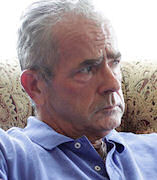
Mike Hilliard. [Source: Mary Schwalm / North Andover Eagle-Tribune]
The air traffic control tower at Logan International Airport in Boston is called by the FAA's Boston Center and told that communication with Flight 11 has been lost, but when the tower supervisor looks at the plane through his binoculars, he can see nothing outwardly wrong with it. [North Andover Eagle-Tribune, 9/6/2011; CNHI News Service, 9/9/2011]

Flight 11 took off from Logan Airport at 7:59 a.m. (see (7:59 a.m.) September 11, 2001). It was in communication with the Logan control tower before being passed on to the FAA's Boston Center. All communications between the Logan tower and Flight 11 were routine, and tower operators received no indication that anything was wrong with the flight. [Boston Globe, 9/12/2001; Federal Aviation Administration, 9/17/2001 pdf file; New York Times, 10/16/2001]

But since the Boston Center instructed it to ascend to 35,000 feet, just before 8:14 a.m. (see 8:13 a.m. September 11, 2001), Flight 11 has failed to respond to all air traffic controller communications (see 8:14 a.m.-8:24 a.m. September 11, 2001). [Federal Aviation Administration, 9/17/2001 pdf file; New York Times, 10/16/2001; 9/11 Commission, 8/26/2004, pp. 7]

Tower Supervisor Sees Nothing Wrong with Flight 11 - The Boston Center now calls the Logan tower to alert it to the problem. "We got a call in the tower that communication with the plane had been lost," Mike Hilliard, the tower supervisor, will later recall.


Then, Hilliard will say, the radar room, which is on a level below the tower room, "called and asked if we could still see the plane." Hilliard looks at the radar screen and can see Flight 11's track. He then grabs his binoculars, looks out the window through them, and can see Flight 11, because the sun is reflecting off its aluminum fuselage. The aircraft is flying "at 15,000 feet, and he wasn't trailing vapor or smoke," Hilliard will recall. Hilliard therefore informs the radar room that he cannot see anything wrong with the plane.

Assistant Says, 'I Hope It's Not a Hijack' - One of Hilliard's assistants then says to the supervisor, "I hope it's not a hijack." This gives Hilliard an uneasy feeling. He replies, "It better not be, because if they got the airplane that quick, it's a team that took the airplane." He says to his assistant that the problem with Flight 11 has "got to be mechanical," and then adds, "Nobody can get a plane that quick." [North Andover Eagle-Tribune, 9/6/2011; CNHI News Service, 9/9/2011]

The 9/11 Commission will conclude that Flight 11 is hijacked at around 8:14 a.m. (see 8:14 a.m. September 11, 2001). Flight 175, the second plane to crash into the World Trade Center, takes off from Logan Airport at 8:14 a.m. (see 8:14 a.m. September 11, 2001). [9/11 Commission, 7/24/2004, pp. 4, 7]
#107
After Flight 11 fails to respond to an instruction from air traffic control to climb to 35,000 feet (see 8:13 a.m. September 11, 2001), the controller handling it, Pete Zalewski, tries to regain contact with the aircraft. Over the following ten minutes, he makes numerous attempts but without success. (Zalewski says he makes 12 attempts; the 9/11 Commission says nine.) He tries reaching the pilot on the emergency frequency. Zalewski later recalls that initially, "I was just thinking that it was, you know, maybe they—pilots weren't paying attention, or there's something wrong with the frequency.... And at first it was pretty much, you know, 'American 11,' you know, 'are you paying attention? Are you listening?' And there was still no response." He says, "I went back to the previous sector to see if the pilot had accidentally flipped the switch back over on the—on the radio." But as Zalewski is repeatedly unable to get any response from Flight 11, he recalls, "I even began to get more concerned." However, Zalewski claims, it is not until he sees the plane's transponder go off at around 8:21 that he suspects something is "seriously wrong," and calls his supervisor for assistance (see (8:21 a.m.) September 11, 2001). And it is not until about 8:25 that he realizes for sure that he is dealing with a hijacking (see (8:25 a.m.) September 11, 2001).

It is only then that Boston Center starts notifying its chain of command that Flight 11 has been hijacked (see 8:25 a.m. September 11, 2001). [New York Times, 10/16/2001; MSNBC, 9/11/2002; 9/11 Commission, 7/24/2004, pp. 18; 9/11 Commission, 8/26/2004, pp. 7 and 10-11]
#108
The last routine communication takes place between air traffic control and the pilots of Flight 11 at 8:13 and 29 seconds. Boston Center air traffic controller Pete Zalewski is handling the flight, and instructs it to turn 20 degrees to the right. Pilot John Ogonowski immediately acknowledges the instruction, but seconds later he fails to respond to a command to climb to 35,000 feet. Zalewski repeatedly tries to reach the pilot over the next ten minutes, even using the emergency frequency, but gets no response (see 8:14 a.m.-8:24 a.m. September 11, 2001). The 9/11 Commission concludes that Flight 11 is hijacked at 8:14, or shortly afterwards (see 8:14 a.m. September 11, 2001). [New York Times, 10/16/2001; MSNBC, 9/11/2002; 9/11 Commission, 6/17/2004; 9/11 Commission, 7/24/2004, pp. 4]
#109
Shortly after air traffic controllers ask Flight 11 to climb to 35,000 feet, its transponder stops transmitting. A transponder is an electronic device that identifies a plane on a controller's screen and gives its exact location and altitude. Among other vital functions, it is also used to transmit a four-digit emergency hijack code. Flight control manager Glenn Michael later says, "We considered it at that time to be a possible hijacking." [Christian Science Monitor, 9/13/2001; MSNBC, 9/15/2001; Associated Press, 8/12/2002]

Initial stories after 9/11 suggest the transponder is turned off around 8:13 a.m., but Pete Zalewski, the air traffic controller handling the flight, later says the transponder is turned off at 8:20 a.m. [MSNBC, 9/11/2002]

The 9/11 Commission places it at 8:21 a.m. [9/11 Commission, 6/17/2004] Colonel Robert Marr, head of NEADS, claims the transponder is turned off some time after 8:30 a.m. where the Flight 11 hijack was first detected a.m. [ABC News, 9/11/2002]
#110


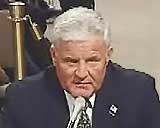
Mike Canavan testifying before the 9/11 Commission.
[Source: C-SPAN]
Protocols in place on 9/11 state that if the FAA requests the military to go after an airplane, "the escort service will be requested by the FAA hijack coordinator by direct contact with the National Military Command Center (NMCC)." [Federal Aviation Administration, 11/3/1998]

Acting FAA Deputy Administrator Monte Belger states essentially the same thing to the 9/11 Commission, "The official protocol on that day was for the FAA headquarters, primarily through the hijack coordinator... to request assistance from the NMCC if there was a need for [Defense Department] assistance." [9/11 Commission, 6/17/2004]

However, the hijack coordinator, FAA Office of Civil Aviation Security Director Mike Canavan, is in Puerto Rico and claims to have missed out on "everything that transpired that day." The 9/11 Commission fails to ask him if he had delegated that task to anyone else while he was gone. [9/11 Commission, 5/23/2003; 9/11 Commission, 7/24/2004, pp. 17]

Monte Belger will later say simply that "an FAA security person" runs the "hijack net" open communication system during 9/11. [9/11 Commission, 6/17/2004]
#111


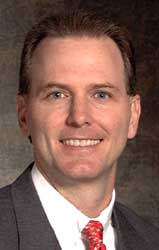
Gerard Arpey.
[Source: American Airlines]
Gerard Arpey, American Airlines' executive vice president of operations, learns of the trouble on Flight 11 and then heads to the airline's System Operations Control (SOC) center, but he is unable to contact the airline's president to alert him to the crisis at this time. [9/11 Commission, 1/8/2004 pdf file]

Arpey Told about Call from Flight Attendant - At around 8:30 a.m., Arpey, who is in his office at American Airlines' headquarters in Fort Worth, Texas, makes a routine phone call to the nearby SOC. [9/11 Commission, 1/27/2004; 9/11 Commission, 8/26/2004, pp. 12]

The call is answered by Joseph Bertapelle, the manager of SOC operations coordination/air traffic systems. [9/11 Commission, 1/8/2004 pdf file] Bertapelle tells Arpey about a phone call the airline has received from Betty Ong, a flight attendant on the hijacked Flight 11. [9/11 Commission, 1/27/2004; 9/11 Commission, 8/26/2004, pp. 12]

Since 8:18 a.m., Ong has been on the phone with employees at the American Airlines Southeastern Reservations Office in North Carolina (see 8:18 a.m. September 11, 2001), and one of those employees has been relaying the information Ong provides to Craig Marquis, the manager on duty at the SOC (see (8:21 a.m.) September 11, 2001). [9/11 Commission, 11/19/2003 pdf file; 9/11 Commission, 8/26/2004, pp. 8-9]

Arpey Wonders if Ong's Call Is Genuine - Bertapelle tells Arpey that Marquis has learned that Ong said there were "bad guys" on her plane and a flight attendant had been stabbed. Arpey wonders if the call from Ong is genuine. Considering the number of "crank" calls the airline receives, he will later comment, he is "conditioned to be somewhat skeptical." However, when Bertapelle says Ong has reported a cockpit intrusion (see 8:22 a.m.-8:24 a.m. September 11, 2001), this information makes Arpey think "that the incident could be the real thing."


Arpey Unable to Reach Airline's President - Immediately after the call with Bertapelle ends, Arpey tries calling Don Carty, the president of American Airlines, to let him know what is happening. [9/11 Commission, 1/8/2004 pdf file; 9/11 Commission, 8/26/2004, pp. 12]

But Carty is at home answering e-mails and so has not yet arrived at his office. Arpey therefore leaves a message, requesting that Carty call him as soon as possible.

Arpey Heads to Operations Center, Learns Details of Hijacking - Arpey briefs his executive assistant on what he has learned about the trouble on Flight 11. [Wall Street Journal, 10/15/2001; 9/11 Commission, 1/27/2004]

He then heads to the SOC, along with Dan Huffman, American Airlines' senior vice president of maintenance and engineering. [9/11 Commission, 1/8/2004 pdf file]

The SOC is about a mile away from the airline's headquarters, and Arpey will recall that he arrives there at between 8:35 a.m. and 8:40 a.m. After he reaches the SOC, managers there tell him they are now treating Flight 11 as a confirmed hijacking. Arpey is told that the plane's pilots are still not responding to calls from the flight attendants and that Ong said a passenger in first class had been stabbed, possibly fatally (see 8:33 a.m. September 11, 2001). He learns that the FAA has notified the airline that, instead of heading west on its intended flight path, Flight 11 is heading south; the plane's transponder has been turned off; and the pilots are not responding to radio calls (see 8:29 a.m. September 11, 2001). [9/11 Commission, 1/27/2004]

Arpey also learns that airline managers are setting up the System Operations Command Center in order to deal with the emergency (see (Between 8:40 a.m. and 8:55 a.m.) September 11, 2001), and because they are doing this, he will say, he "knew that they had concluded the incident was real." [9/11 Commission, 1/8/2004 pdf file; 9/11 Commission, 8/26/2004, pp. 12]

As executive vice president of operations, Arpey is responsible for American Airlines' worldwide flight operations, and he will therefore be directly involved in the airline's subsequent emergency response efforts and other operational decisions throughout the day. [9/11 Commission, 1/27/2004]

#112


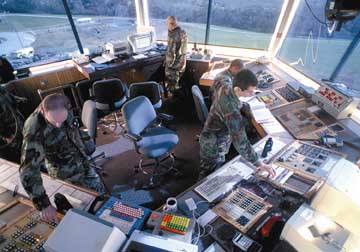
Offutt Air Force Base control tower during Global Guardian 1998. [Source: Jeffery S. Viano]
As the 9/11 attacks are taking place, a large military training exercise called Global Guardian is said to be "in full swing." It has been going on since the previous week. [Omaha World-Herald, 2/27/2002; Omaha World-Herald, 9/10/2002]

Global Guardian is an annual exercise sponsored by US Strategic Command (Stratcom) in cooperation with US Space Command and NORAD. One military author defines Stratcom as "the single US military command responsible for the day-to-day readiness of America's nuclear forces." [Arkin, 2005, pp. 59]

Exercise Tests Military's Ability to Fight a Nuclear War - Global Guardian is a global readiness exercise involving all Stratcom forces and aims to test Stratcom's ability to fight a nuclear war. It is one of many "practice Armageddons" that the US military routinely stages. [Bulletin of the Atomic Scientists, 11/1/1997; Associated Press, 2/21/2002; Omaha World-Herald, 2/27/2002; Omaha World-Herald, 9/10/2002]

It links with a number of other military exercises, including Crown Vigilance (an Air Combat Command exercise), Apollo Guardian (a US Space Command
exercise), and the NORAD exercises Vigilant Guardian and Amalgam Warrior. [US Department of Defense, 5/1997; GlobalSecurity (.org), 4/27/2005]

Global Guardian is both a command post and a field training exercise, and is based around a fictitious scenario designed to test the ability of Stratcom and its component forces to deter a military attack against the US. Hundreds of military personnel are involved. [US Congress, n.d.; Collins Center Update, 12/1999 pdf file; Times-Picayune, 9/8/2002]

The exercise involves "a lot of the elements of what ultimately would be the nuclear command and control system in support of a national emergency," according to Admiral Richard Mies, the commander in chief of Stratcom. It includes an "exercise secretary of defense" and "an exercise president." Mies will say that because of the exercise, "A lot of [Stratcom's] command and control systems that, in peacetime, are normally not on alert were at a much, much higher state of alert [on September 11] and we had a number of aircraft, manned control aircraft that were airborne that were simulating their wartime roles." [NET News, 12/27/2011]

Exercise Normally Held in October or November - According to a 1998 Internet article by the British American Security Information Council—an independent research organization—Global Guardian is held in October or November each year. [Kristensen, 10/1998]

In his book Code Names, NBC News military analyst William Arkin dates this exercise for October 22-31, 2001. [Arkin, 2005, pp. 379] And a military newspaper reported in March 2001 that Global Guardian was scheduled for October 2001. [Space Observer, 3/23/2001, pp. 2 pdf file]

If this is correct, then some time after March, the exercise must have been rescheduled for early September.

Exercise Includes a 'Computer Network Attack' - Furthermore, a 1998 Defense Department newsletter reported that for several years Stratcom had been incorporating a computer network attack (CNA) into Global Guardian. The attack involved Stratcom "red team" members and other organizations acting as enemy agents, and included attempts to penetrate the command using the Internet and a "bad" insider who had access to a key command and control system. The attackers "war dialed" the phones to tie them up and sent faxes to numerous fax machines throughout the Command. They also claimed they were able to shut down Stratcom's systems. Reportedly, Stratcom planned to increase the level of computer network attack in future Global Guardian exercises. [IAnewsletter, 6/1998 pdf file]

It is unclear if a computer network attack is incorporated into Global Guardian in 2001.

Entity Tags: US Strategic Command, Apollo Guardian, Crown Vigilance, Global Guardian, North American Aerospace Defense Command, US Department of Defense, US Space Command, Vigilant Guardian, Amalgam Warrior, Richard Mies
#113
Air Sovereignty Alert (ASA) preparedness

Background

In January 1982, the FAA unveiled the National Airspace System (NAS) Plan. The plan called for more advanced systems for Air Traffic Control, and improvements in ground-to-air surveillance and communication with new Doppler Radars and better transponders. Better computers and software were developed, air route traffic control centers were consolidated, and the number of flight service stations reduced. There is no overlap of responsibility between DoD and FAA within the NAS: this is why within FAA-controlled airspace the FAA is in charge of controlling and vectoring hijack intercept aircraft.

The radar systems at NEADS had been scheduled to be upgraded in a contract awarded in 1997, but the project cost had been revised upwards by 700% causing the Air Force to cancel the contract and begin plans to re-open the bidding process.

Planning for terrorist use of hijacked airplanes as missiles had been considered for some military exercises prior to 9/11, though all but one of those exercises considered only aircraft originating from other countries.

The US and Canadian militaries, particularly NORAD and the US Air National Guard, have been tasked with interception duties concerning hijacked aircraft. Their primary duty was assistance to law enforcement. Quoting Maj.Gen. Larry Arnold: "We always viewed an attack from within our borders as a law enforcement issue, ...". Military aircraft were to be used to assure positive flight following, report unusual observances, and aid search and rescue in the event of an emergency. Jamie Gorelick of the 9-11 Commission had taken part in those security measures as Deputy Attorney General, and described the measures in Commission hearings. In April 2001, NORAD considered an exercise in which an aircraft of foreign origin was hijacked by terrorists and flown into the Pentagon, like a missile, but rejected the scenario as implausible. Five months later, a similar scenario occurred. However, in January 2002 Maj.Gen. Larry Arnold, stated "...we did not honestly think about hijacked airliners being used in suicide attacks."

Efforts post-9/11

In April 2003, a contract was awarded to upgrade the Battle Control Systems, operational date by summer 2006.

Later systems, such as the Joint-Based Expeditionary Connectivity Center (JBECC), merge civil and military radar data. Once deployed, the JBECC can fuse and correlate target data covering about 400 miles (640 km) of coastline from disparate airborne, land- and sea-based sensors creating fire-control-quality tracks that can guide interceptors to engagement.

Major General Larry Arnold, USAF, ret. stated in May 2001, that JBECC will provide "... more time to scramble fighters and see any target, whether small, large, low or high."

General Arnold also stated "In the immediate aftermath of 9/11 we had to hook up to FAA radars throughout the country, install compatible radios for nationwide coverage between our command and control agencies and our airborne assets, and purchase a new command and control computer system to integrate radar and communications. The initial investment was for $75 million, and this number has grown to nearly $200 million."

Organizations outside the FAA (e.g., the airlines, Department of Defense, NASA, and international sites) also have access to the FAA's Enhanced Traffic Management System (ETMS) software and/or data for purposes of flight management and tracking.

2009 Government Accountability Office report on ASA

In January 2009, the Government Accountability Office (GAO) published "Homeland Defense: Actions Needed to Improve Management of Air Sovereignty Alert Operations to Protect U.S. Airspace" on the Air Force's Air Sovereignty Alert mission. According to the report:

    The Air Force has not implemented ASA operations in accordance with DOD, NORAD, and Air Force directives and guidance, which instruct the Air Force to establish ASA as a steady-state (ongoing and indefinite) mission. The Air Force has not implemented the 140 actions it identified to establish ASA as a steady-state mission, which included integrating ASA operations into the Air Force's planning, programming, and funding cycle. The Air Force has instead been focused on other priorities, such as overseas military operations. While implementing ASA as a steady-state mission would not solve all of the challenges the units must address, it would help them mitigate some of the challenges associated with conducting both their ASA and war fighting missions.

The report further stated:

    The GAO analysis also showed that none of the Air Force's key homeland defense documents—the Air Force homeland defense policy directive, the Air Force homeland operations doctrine, and the Air Force homeland defense concept of operations—fully defines the roles and responsibilities for, or accurately articulates the complexity of, Air Sovereignty Alert operations.

The report made the following recommendations to improve ASA operations:

    We recommend that the Secretary of Defense direct the Commander of the U.S. command element of NORAD to routinely conduct risk assessments to determine ASA requirements, including the appropriate numbers of ASA sites, personnel, and aircraft to support ASA operations.

    We recommend that the Secretary of Defense direct the military services with units that consistently conduct ASA operations to formally assign ASA duties to these units and then ensure that the readiness of these units is fully assessed, to include personnel, training, equipment, and ability to respond to an alert.

    We recommend that the Secretary of Defense direct the Secretary of the Air Force to take the following five actions:

        • Establish a timetable to implement ASA as a steady-state mission.
        • Implement ASA as a steady-state mission according to NORAD, DOD, and Air Force guidance by

        • updating and implementing the ASA program action directive;
        • updating the Air Force homeland defense policy, homeland operations doctrine, and concept of operations to incorporate and define the roles and responsibilities for ASA operations; and incorporating the ASA mission within the Air Force submissions for the 6-year Future Years Defense Program.

        • Develop and implement a plan to address any projected capability gaps in ASA units due to the expected end of the useful service lives of their F-15s and F-16s.
        • Develop and implement a formal method to replace deploying units that still provides unit commanders flexibility to coordinate replacements.

#114
NORAD timeline

On September 18, 2001, NORAD issued a press release containing a timeline of the events of the September 11, including when they were contacted by the FAA. This page has been removed, but a copy can be found at archive.org. However, in 2004, the 9/11 Commission, after listening to tapes of communications, found that portions of this timeline were inaccurate. The NORAD timeline had served as the official account of the military response, and elements of that timeline appeared in the book Air War over America (notably information concerning United Flight 93, e.g., pages 59 and 63) and was given in testimony to the 9/11 Commission by NORAD's Major General Larry Arnold (retired), and Colonel Alan Scott (retired) in 2003.

    Concerning Col. Scott's statements to the Commission. From Vanity Fair, August, 2006, page 5 of 9: —

        In the chronology presented to the 9/11 commission, Colonel Scott put the time NORAD was first notified about United 93 at 9:16 a.m., from which time, he said, commanders tracked the flight closely. (It crashed at 10:03 a.m.) If it had indeed been necessary to "take lives in the air" with United 93, or any incoming flight to Washington, the two armed fighters from Langley Air Force Base in Virginia would have been the ones called upon to carry out the shootdown. In Colonel Scott's account, those jets were given the order to launch at 9:24, within seconds of NEADS's receiving the F.A.A.'s report of the possible hijacking of American 77, the plane that would ultimately hit the Pentagon. This time line suggests the system was starting to work: the F.A.A. reports a hijacking, and the military reacts instantaneously. Launching after the report of American 77 would, in theory, have put the fighters in the air and in position over Washington in plenty of time to react to United 93.

    Concerning Gen. Arnold's statements to the Commission. From Vanity Fair, August, 2006, page 5 of 9: —

        Major General Arnold explained to the commission that the military had been tracking United 93 and the fighters were in position if United 93 had threatened Washington. "It was our intent to intercept United Flight 93," Arnold testified. "I was personally anxious to see what 93 was going to do, and our intent was to intercept it."

        In testimony a few minutes [following Col Scott's testimony], however, General Arnold added an unexpected twist: "We launched the aircraft out of Langley to put them over top of Washington, D.C., not in response to American Airlines 77, but really to put them in position in case United 93 were to head that way."

    Problems with the officers' statements to the Commission. From Vanity Fair, August, 2006, page 5 of 9: —

        As the tapes [of F.A.A. and military communications on 9/11] reveal in stark detail, parts of Scott's and Arnold's testimony were misleading, and others simply false. At 9:16 a.m., when Arnold and [NEADS commander Colonel Robert] Marr had supposedly begun their tracking of United 93, the plane had not yet been hijacked. In fact, NEADS wouldn't get word about United 93 for another 51 minutes. And while NORAD commanders did, indeed, order the Langley fighters to scramble at 9:24, as Scott and Arnold testified, it was not in response to the hijacking of American 77 or United 93. Rather, they were chasing a ghost [Flight 11]. NEADS was entering the most chaotic period of the morning.

The Washington Post reported in its August 3, 2006, edition that:

    "Some staff members and commissioners of the Sept. 11 panel concluded that the Pentagon's initial story of how it reacted to the 2001 terrorist attacks may have been part of a deliberate effort to mislead the commission and the public rather than a reflection of the fog of events on that day, according to sources involved in the debate.

    Suspicion of wrongdoing ran so deep that the 10-member commission, in a secret meeting at the end of its tenure in summer 2004, debated referring the matter to the Justice Department for criminal investigation, according to several commission sources. Staff members and some commissioners thought that e-mails and other evidence provided enough probable cause to believe that military and aviation officials violated the law by making false statements to Congress and to the commission, hoping to hide the bungled response to the hijackings, these sources said."

In their 2007 book, Without Precedent, 9/11 Commission chairmen Thomas Kean and Lee H. Hamilton wrote that 9/11 conspiracy theories had grown primarily because of problems in the previous story about the planes:

"If the military had had the amount of time they said they had ... and had scrambled their jets, it was hard to figure out how they had failed to shoot down at least one of the planes. ... In this way, the FAA's and NORAD's inaccurate reporting after 9/11 created the opportunity for people to construct a series of conspiracy theories that persist to this day." "The tapes recordings ... from the day were extremely important – they provided a real-time record of what was happening that enabled our staff to relive the day, instead of relying solely on people's memory or their hurried notes of what took place."

The NORAD timeline showed that the FAA had notified NORAD earlier than the taped evidence indicated, and the 9/11 Commission Report faulted the FAA for not contacting NORAD quickly enough. The NORAD timeline showed notification of the hijacking of Flight 175 at 08:43, while the tapes show NORAD was notified at the same time Flight 175 hit the South Tower at 09:03. According to Scoggins, however, "With American Airlines, we could never confirm if [Flight 11] was down or not, so that left doubt in our minds."

According to the 9/11 Commission report, at approximately 08:32, the FAA's Herndon Command Center established a teleconference between Boston, New York, and Cleveland Centers so that Boston Center could help the others understand what was happening. Controllers at the Boston Center knew American Airlines Flight 11, which departed at 07:59 from Boston for its flight to Los Angeles, was hijacked 30 minutes before it crashed. They tracked it to New York on their radar scopes: 'I watched the target of American 11 the whole way down,' said Boston controller Mark Hodgkins. Several Boston controllers tracked American 11 for its entire flight.

The FAA mistakenly thought Flight 11 was still possibly airborne, in part because American Airlines did not confirm that they had lost all contact with Flight 11 until some time after 10:00. The NORAD timeline showed that the fighters scrambled from Langley at 09:24 were in response to a 09:21 FAA report of the hijacking of Flight 77; NORAD never mentioned the phantom Flight 11.

    From Michael Bronner of Vanity Fair:

        The problem, Scoggins told me later, was that American Airlines refused to confirm for several hours that its plane had hit the tower. This lack of confirmation caused uncertainty that would be compounded in a very big way as the attack continued. (Though airlines have their own means of monitoring the location of their planes and communicating with their pilots, they routinely go into information lockdown in a crisis.)

In October 2003, the 9/11 Commission issued a subpoena to the FAA to turn over documents after the Commission's investigators determined that material had been withheld. A tape was made of oral statements of New York air traffic controllers, intended to be used as an aid in their making written statements, then destroyed. A quality assurance manager at the FAA's New York Center denied the staff access to the tape and later destroyed it. Its existence came to light in 2003 interviews with FAA staff. The Commission subpoenaed the tape and other records from the FAA on Oct. 16, 2003. In November 2003, the Commission issued a subpoena to NORAD; its second subpoena issued to a federal agency for failure to turn over documents.

In July 2004, the 9/11 commission made referrals to the Inspectors General of both the US Department of Transportation and the Defense Department to further investigate whether witnesses had lied.

    Commission staff believes there is sufficient evidence that the false statements made to the commission were deliberately false. [John Farmer, Jr., the commission's senior counsel]

The DoD Inspector General's report was released to the New York Times in August 2006 under a FOIA request. According to the report, military officials were exonerated of intentionally misleading the 9/11 Commission in their testimony. A summary of the report called for more steps to improve the Defense Department's ability to investigate "a future significant air event," including more effective event logging methods

The US Transportation Department's Inspector General's investigation report was released on August 31, 2006. FAA personnel were also exonerated of knowingly misleading the 9/11 Commission.
#115
Phantom Flight 11

NEADS received another call from Colin Scoggins, who reported erroneously that Flight 11 was not, in fact, the aircraft that hit the North Tower at 08:46, as had been previously believed, but that it was still in the air and heading towards Washington. NEADS responded to this report by giving a scramble order to three fighters from the 1st Fighter Wing on alert at Langley Air Force Base at 09:24, and by 9:30 they were in the air. According to the 9/11 commission, the Langley pilots were never briefed by anyone at their base about why they were being scrambled, so, despite Langley officials' having been given the order from NEADS to fly to Washington, the unbriefed pilots ended up following their normal training flight plan, due east, out to sea. The fighters then flew north-west towards Washington, arriving around 10:00.
#116
The controller at Otis directed Boston to contact NORAD's Northeast Air Defense Sector (NEADS), and then informed the Otis Operations Center to expect a call from NEADS ordering a scramble. At this time two pilots began to suit up and drove to their waiting F-15 fighter jets
#117
Herndon called FAA Headquarters in Washington
#118
The Boston Center called the FAA Command Center at Herndon to report the hijacking
#119
According to the 9/11 commission, the Langley pilots were never briefed by anyone at their base about why they were being scrambled, so, despite Langley officials' having been given the order from NEADS to fly to Washington, the unbriefed pilots ended up following their normal training flight plan, due east, out to sea. The fighters then flew north-west towards Washington, arriving around 10:00.
#120
Fighter Scramble - Order (Langley AFB, Hampton, Va. 2 F-16s)